2-year vs 5-year fixed mortgage: Which should you choose?
We looked at over 41,000 mortgage quotes to find out how borrowers really split between 2-year and 5-year fixed mortgages. We dive into the data, plus advice to help you decide, too.


Key takeaways:
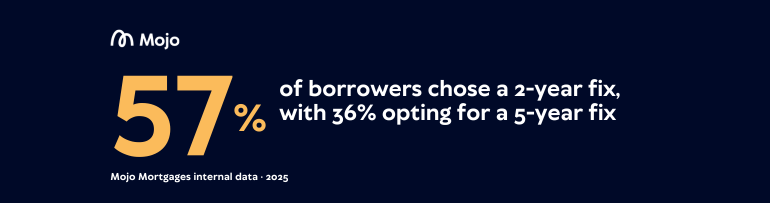
Mojo research found that 57% of borrowers choose a 2-year fix; 36% choose a 5-year fix. Most are betting rates will fall, not chasing the cheapest deal today.
First-time buyers are the only group that prefers 5-year fixes (52% vs 41%) — everyone else leans short.
Remortgagers are nearly twice as likely to fix for 2 years as 5 (61.5% vs 29.9%).
97% of borrowers end up with the deal length they said they wanted at their very first enquiry, this decision is largely made before anyone speaks to a lender.
Six lenders handle over half of these mortgage quotes: Nationwide, HSBC, Barclays, NatWest, Halifax and Santander.
Choosing the length of a fixed-rate mortgage
What to consider when deciding on your next deal.
Choose a 2-year fix if: | Choose a 5-year fix if: |
|---|---|
You think interest rates will fall within the next 2-3 years | You need budget certainty for 5 years |
You are moving house or selling up soon | You’re a first-time buyer stretching your affordability |
You’re a remortgager comfortable with the process | You want to remortgage as few times as possible |
You’re willing to pay arrangement fees more often | You’re worried about payment shock from a rate rise |
Borrowers are favouring a 2-year fix in 2026
Most borrowers choose a 2-year fixed mortgage over a 5-year fix. According to Mojo Mortgages' analysis of 41,865 mortgage quotes, 57% of borrowers choose a 2-year fix compared with 36% choosing a 5-year fix, with the remaining 7% split mostly across 3-year deals.
The exception is first-time buyers, 52% of whom prefer the certainty of a 5-year fix, while remortgagers lean short by nearly 2 to 1 (61.5% vs 29.9%).
Deal length | Share of quotes (Mojo internal data) |
|---|---|
2-year fix | 56.9% |
5-year fix | 35.7% |
3-year fix | 6.4% |
1 year or less | 0.7% |
10 years or more | 0.2% |
That's nearly 6 in 10 borrowers opting for the shorter fix. This could tell us that most borrowers aren’t chasing the cheapest rate on the day, but instead, wagering that rates will fall within a couple years, so that they’re not locking themselves out of a better deal later.
Which mortgage lenders offer 2-year and 5-year deals?
In our research, we found that 6 lenders account for 70% of all quotes in the dataset: Nationwide (16.3%), HSBC (14.4%), Barclays (12.5%), NatWest (11.9%), Halifax (9.2%) and Santander (5.9%)..
Buy-to-let is its own separate market: landlords' top two lenders are specialist arms, BM Solutions (21%) and The Mortgage Works (14%), which barely feature in residential quotes at all.
Lender | 2-year | 3-year | 5-year |
|---|---|---|---|
NatWest | 51% | 0% | 49% |
Virgin Money | 49% | 4% | 47% |
HSBC | 52% | 4% | 44% |
Barclays | 64% | 1% | 35% |
Halifax | 50% | 18% | 32% |
Nationwide | 53% | 11% | 36% |
Because quotes tend to reflect who's pricing most competitively at a given moment, the lender-level split by deal length is a signal of where each lender's sharpest pricing sat during this period, rather than a statement about their product range.
2 year vs 5 year fixed mortgage by borrower type
Borrower type | Sample size | 2-year fix | 3-year fix | 5-year fix |
|---|---|---|---|---|
First-time buyers | 6,316 | 41% | 6% | 52% |
Home movers | 4,675 | 49% | 6% | 42% |
Remortgagers | 26,446 | 61% | 7% | 29% |
Buy-to-let landlords | 4,393 | 59% | 1% | 39% |
First-time buyers are the only group that actually prefers the 5-year fix, and by a small but defined margin: 52% versus 41%. That tracks with intuition: first-time buyers are typically stretching their budget hardest, have no track record of navigating a remortgage before, and have the most to lose from a payment shock. Certainty can be worth paying for, if that’s possible, when the alternative tends to be stressful.
Remortgagers lean hard the other way. They're nearly twice as likely to fix for 2 years as for 5 (61.5% vs 29.9%). These are borrowers who have already been through the process at least once, know what a remortgage involves, and are typically further into building equity — all of which lowers the cost of being wrong and being flexible.
Home movers sit almost exactly in the middle (49.5% vs 42.8%), which makes sense, since this group is really a mix of first-time-buyer-like caution and remortgager-like experience, depending on how many times they've moved before.
Buy-to-let landlords skew short (59.6% 2-year), and almost none of them touch a 3-year deal (1.2%, against a 6.4% market average). We could say that landlords appear to view the 3-year fix as neither one thing nor the other.
Should I get a 2 or 5 year fixed mortgage?
There’s no universally right answer, but these 6 questions can help you narrow down a decision.
1. Review rates and expectations
If you think that the rates are heading down, you may be tempted to lean toward a 2-year fix so that you may be able to refix at a lower rate sooner. If you think rates will hold or rise, you may want to lock in for longer by going for a 5-year fix.
Right now this factor is unusually scrambled because 5-year rates have actually dipped below 2-year rates in some cases, which can be a signal the market is pricing in future cuts, which is pushing more people toward 5-year fixes.
2. How long you’ll stay in the property
If you’re planning to move, sell, or upsize within a few years then a 2-year fix is likely the right option to avoid early repayment charges on a longer deal. If you’re planning to settle in for the long haul (especially first-time buyers) then it can be worth going for a 5-year fix, since a longer-term deal works well when you're confident you'll be staying in the home.
3. Fees and risk
Remortgage deals typically come with an arrangement fee (often £995–£1,500+) and paperwork. A 2-year fix means going through that twice as often over a 5-year horizon. Some people would rather pay once and be done; others would rather pay the fee more often to stay closer to the market rate.
4. Budget and certainty
If you're stretching to afford the mortgage, the 5-year fix wins almost every time, knowing exactly what you'll pay for 5 years makes budgeting far easier. Flexibility is a luxury for those who can absorb a rate change; certainty is a necessity for those who can't.
5. Loss aversion
Would you be more annoyed locking in 5 years and watching rates fall, or locking in 2 years and getting hit by a rise? People's answer to that question, more than any spreadsheet, tends to decide it.
6. Early repayment charges (ERC)s
Longer fixes generally carry higher or longer-lasting ERCs if you need to exit early (job loss, relationship change, unexpected move). People who value optionality even at a cost will pay slightly more for a 2-year fix just to keep that door open.
How firmly you already feel about it matters most of all. With 97% of borrowers ending up exactly where they said they would at their very first enquiry, this is one financial decision where "sleeping on it" rarely changes the outcome, so it's worth thinking it through properly before that first conversation, not during it. A mortgage broker can also handle the paperwork and application either way, which lowers the cost of whichever choice you make.
2-year and 5-year fixed mortgages: FAQs
Neither is better, it depends on your situation. Our data shows that 57% of borrowers favour a 2-year fix, generally better rates will fall, while first-time buyers prefer the 5-year fix. What is right for you depends on your situation.
In 2026, 5-year fixed rates have, at times, dipped below 2-year rates, which has made the 5-year deals more attractive. Even so, we found that 57% of borrowers in our dataset choose a 2-year fixed-rate mortgage, primarily because they want the option to refix sooner if rates fall.
A mortgage broker can help you decide and give you the latest rates and options.
Yes, but you’ll usually pay an Early Repayment Charge (ERC), which is typically 1-5% of the outstanding loan. Take note that ERCs are higher the earlier you exit. Within a 5-year fix, leaving in year 2 will likely cost more than on a 2-year fix at the same stage. ERCs are typically waived when porting your mortgage to a new property (with the same lender).
We found that the first-time buyer group preferred fixing their mortgage for 5 years (52%), as per our internal data. They’re typically borrowing at the maximum affordability, have no previous remortgage experience, and value knowing their monthly payment won’t change for 5 years. For this group, perhaps certainty tends to outweigh flexibility.
Remortgages, we found, chose a 2-year fix nearly twice as often as a 5-year fix (61.5% vs 29.9%). They’ve been through the process before, are comfortable with the admin, and are usually further into building equity, which lowers the cost of being wrong. They’re more likely to actively monitor rates and act when a better deal surfaces.
Sources and data
Disclaimer: Every effort is made to provide accurate information as of the publishing date. However, given the fast-moving nature of the mortgage market, products or rates may have changed since this was written.
Deal-length figures and lender data are drawn from an internal analysis of 41,865 Mojo Mortgage mortgage quotes, categorised by quoted initial term. Figures describe quotes recommended to borrowers rather than completed mortgages.