Mortgages for contractors
Find the right contractor, self-employed, and limited company director mortgage for you.
Last reviewed: 30 July 2026


Key takeaways:
Contractors are often able to access the same rates as employed borrowers, depending on the lender.
Your mortgage broker should calculate the 46-week vs 52-week to compare figures for borrowing.
A mortgage broker can help contractors, the self-employed, freelancers, and directors find the right mortgage deal.
In this guide

Getting a mortgage as a contractor
While some mortgage lenders still prefer applicants with traditional employment, contractors, those that work on a day rate, can get a mortgage. If you’re a contractor, you may not necessarily fall into self-employed or PAYE applications, which is why it’s a good idea to work with a mortgage broker who can help you with the application and paperwork.
How do mortgage lenders work with contractor income?
As contractor earnings fluctuate, lenders use different ways to calculate affordability, such as the day rate, annualised contract value, or company accounts. Lenders may also consider the length of time contracting, industry demand, and credit score.
Day rate contractors
Usually outside IR35, lenders usually take your gross contract rate and annualise it (typically day rate x 5 days x 46 or 52 weeks) to produce your assessed income figure.
The key variable is the number of working weeks each lender uses, as 46 vs 52 alone shifts annualised income by 13%.
Umbrella contractors
If you work through a third-party umbrella company that handles your payroll, tax, NI, and pays you PAYE, fixed-term contractors and agency workers often fall into a similar bracket when it comes to mortgages. While some lenders treat umbrella payflips as standard PAYE employment and consider take-home pay in affordability calculations, other banks use gross contract value or annualised day rate.
Inside IR35 or outside IR35
IR35 is HMRC’s guidelines for deciding whether a contractor is genuinely self-employed (outside of IR35) or effectively a disguised employee (inside IR35). Outside IR35 will typically have the widest range of lenders, so the right placement matters here.
Working with your contractor type is the first step. Your contract history, gaps, day rate, credit profile and more will impact which lenders accept your mortgage case.
Contractors across the UK
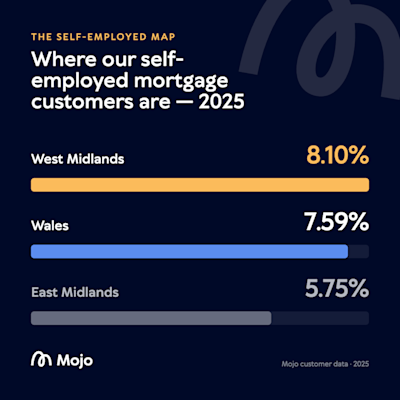
Contractors and freelancers are all across the UK. In 2025, we found that the West Midlands had the highest percentage of self-employed customers (8.10%), with Wales close behind (7.59%). The East Midlands had the lowest percentage of self-employed mortgage applicants (5.75%).*
We also found that sole traders were our highest category of self-employed applicants, at 54%, compared to directors in a limited company at 33% and contractors at 12%.**
Self-employed title and percentage within the category in 2025 | Verification profile |
|---|---|
Sole traders | Relies primarily on net profit from self-assessments (e.g., SA302s). High volume, highly variable income. |
Limited company directors | Complex income structures involving a mix of salary, dividends, and retained business earnings. |
Contractors | Income evaluated via day-rates and contract continuity rather than traditional net profit. |
Can I get a mortgage with gaps between contracts?
Short breaks between contracts are generally considered acceptable, especially in industries where project work is standard. Lenders will look at the length of time of the gap and overall earnings pattern. Most contractor-friendly lenders cap allowable gaps at 4-12 weeks within the last 12 months.
Long or frequent gaps may require additional context or a bigger financial buffer but, typically, they don’t automatically disqualify you from getting a mortgage. That said, your mortgage broker will know which lenders are stricter than others – NatWest allows up to 6 weeks, whereas Bank of Ireland only allows 1 month.
If you’re currently between contracts, applying once a new contract is signed and started (with a good runway of time) could give you access to a wide lender pool.
Lenders typically look at:
Your time contracting
Time in your industry or line of work
Employment gaps between contracts
Contract time remaining
Minimum income thresholds
Number of contracts used for affordability
Income calculation method (using 46 vs 52 weeks)
Do contractors need a bigger deposit?
Depending on your credit history and affordability, many contractors can get mortgages with deposits similar to employed applications. This typically starts from around 5-10%.
If your income is variable or you have a limited history of contracting, it can help to save a larger deposit to access more interest rate options.

46-week vs 52-week income
Contractor-friendly mortgage lenders annualise the day rate over either 46 weeks (which allows for breaks and holidays) or 52 weeks (a full year). This maths matters, as the affordability for the year is compounded.
When calculated, 52 weeks generates 13% more annualised income than 46 weeks, before any other factors. While the 52-week calculation is favourable, some lenders, for example Nationwide, apply an 80% factor on top, which can drop the figure to below a 46-week calculation.
Your mortgage broker should be running these calculations to navigate the different lenders’ policies. The small differences quickly compounds into different maximum borrowing figures.
Mortgages for contractors scenarios
Scenario:
You’re a new contractor
And have a short history of contracting.
If you’ve only been contracting for a few months, but have spent the previous few years doing the same job as a permanent employee, you may still be able to secure a mortgage. Some lenders may want to see at least 1-2 years of accounts, but others may look at your continuity of employment. If your new contract is within the same field and shows stable earnings, it’s possible they’ll accept you based on your current contract rate.
It’s better to have at least 4-6 months remaining on your current contract, but work with a mortgage broker who can help give you the details of your specific situation.
Scenario:
You’re on a fixed-term contract
For example, a 12-month maternity cover or for a specific project.
If you’re employed directly by an organisation on a fixed-term contract, lenders will look at the history of the contract being renewed. Many would also want to see that you have at least 6 months remaining on the current contract. If it’s your first fixed-term contract and nearing the end of it, it’s possible you may need to secure an additional contract or wait until your income looks more predictable and stable.
Gaps between contracts are entirely normal. Most contractor-friendly lenders will tolerate gaps of up to 4 to 6 weeks in a 12-month period without batting an eye, as long as the overall track record is solid.
Scenario:
You’re a first-time buyer contractor
And you want to know your options.
First-time buyer contractors may assume their employment status will be the biggest barrier to their first home purchase. The key is finding a lender that will assess your day rate properly.
For eligible contractors meeting affordability criteria, a 5% deposit first-time buyer contractor mortgage is achievable, while a 10% deposit widens the lender pool, and 15-25% opens it up to more competitive pricing.
Deposits that are gifted are accepted by most contractor-friendly lenders, too.
Once a lender accepts contractor income, you’re able to access the same first-time buyer mortgage deals as employed first-time buyers. Provided you’re eligible, you’d see the same fixed and tracker deals and the same first-time buyer cashback offers when lenders run them. Simply put, there’s no exclusion because of contractor income.

Expert mortgage advice for contractors
Proving your income or finding a mortgage between contracts shouldn't be a headache. Whether you're a newly independent freelancer, a long-term day-rate specialist, or managing your own business, the team at Mojo has your back. We provide free, expert mortgage advice for contractors, from finding the right deal and taking care of the paperwork while you focus on your clients.
Disclaimer: Every effort is made to provide accurate information as of the publishing date. However, given the fast-moving nature of the mortgage market, products, rates, or lender criteria may have changed since this was written.
Sources:
* Data taken from Mojo Mortgages’ own records from 2025 of self-employed customers per postcode region.
** Data taken from Mojo Mortgages’ own records from 2025 of the count of self-employment type of customers.