First-time buyer mortgage advice
Navigate the first-time buyer mortgage with expert advice from mortgage brokers, complete with real-life advice for common situations.

Key takeaways:
Get a mortgage in principle early as sellers are prioritising mortgage-ready buyers
Compare mortgage terms, payments, and fees to get an idea of what’s available to you
Audit your finances before getting a mortgage
Find out how much you can afford by using a mortgage affordability calculator
Using an expert mortgage broker can help guide you through the process
Mortgage deals, rates, and products are subject to lending criteria. The actual amount you can borrow and your final rate will depend on your personal financial situation and is subject to a full application. For a more precise estimate, please get in touch.
In this guide:

First steps
Before looking at homes for sale, you should find out how much you could borrow for a mortgage. The standard is 4.5x your salary, though some lenders are now offering 5.5x salary.
Online mortgage brokers are the norm. You can now get your mortgage in principle, your mortgage offer, and send the paperwork all done online.
Shopping around for the right mortgage can help you find the best deal.
First-time buyer mortgage deposit examples
Mortgage lenders typically require at least 5% of the property price as a deposit. The larger the deposit, the wider the choice of lenders (and, therefore, rates), you have. Generally speaking, if you put down a larger deposit, you’ll get access to better mortgage rates.
Property price | Percentage of deposit | Deposit amount |
|---|---|---|
£300,000 | 5% | £15,000 |
£300,000 | 10% | £30,000 |
£300,000 | 15% | £45,000 |
In 2024, we found that the average deposit of a first-time buyer was £54,881, compared to 2023 when it was £58,321.*
Scenario:
First-time buyer mortgage scenarios:
Scenario: You have a 5% deposit, rather than a 10% deposit
This is currently the most common entry point for buyers who have steady income but limited savings. If you have a 5% deposit, the bank may be willing to lend you the remaining 95% of the property value (which is the loan-to-value (or LTV)).
The interest rates for 95% mortgages are typically slightly higher, since the bank is taking on more risk.
Say you want to buy a property worth £200,000, with a 25-year term mortgage, fixed at 5 years. Here’s an example of what you may expect, depending on your deposit amount.
Loan amount | Deposit % | Deposit | Potential rate | Monthly repayment |
|---|---|---|---|---|
£190,000 | 5% (95% LTV) | £10,000 | 5.25% | £1,144 |
£180,000 | 10% (90% LTV) | £20,000 | 4.84% | £1,041 |
By increasing your deposit from 5% to 10%, in this example, you could save around £103 per month and approximately £6,180 over the initial 5-year fixed period (based on rounded figures).
95% LTV: Representative Example for 5.25% 5-Year Fixed Rate: A mortgage of £190,000 payable over 25 years on a fixed rate. Initial rate 5.25% for 60 months, then 6.49%. 60 months of monthly payments of £1,144.65 followed by 240 payments of £1,265.49. Fees: £999 product fees. Total Amount Payable: £372,396.60. Representative APRC: 6.20%. Rates correct as of 19/05/2026. This is an example and the actual rate and payments will depend on your personal circumstances.
90% LTV: Representative Example for 4.84% 5-Year Fixed Rate: A mortgage of £180,000 payable over 25 years on a fixed rate. Initial rate 4.84% for 60 months, then 6.49%. 60 monthly payments of £1,041.38 followed by 240 payments of £1,191.46. Fees: £999 product fees. Total Amount Payable: £348,433.20. Representative APRC: 6.10%. Rates correct as of 19/05/2026. This is an example and the actual rate and payments will depend on your personal circumstances.
Scenario:
You’re getting a gifted deposit
A gifted deposit – a non-repayable financial gift – can help to take your first step onto the property ladder, especially if you’re struggling to save for the deposit. Our research from 2025** found that 22.7% of first-time buyers received a gifted deposit, compared to 2024 when 26% of buyers had this support.
A gifted deposit is given to support your home-buying purchase, whether it’s a family member, extended family, friends, and sometimes developers on new builds who offer a gifted deposit as an incentive. A gifted deposit can come in many forms, so let your mortgage advisor know if you’ll be using a gifted deposit.
In some cases, lenders may require a gifted deposit letter confirming the money doesn’t need to be repaid and doesn't grant the donor any rights to the property, or they may ask for ID from the donor – but work with your mortgage advisor to understand what documents, if any, are needed.
You have a full-time job and a side hustle
In 2026, lenders have become much better at taking the blended income for individuals with multiple revenue streams.
For example, if you have a day job earning £30,000 and a freelance business that pulls in £5,000 a year, you may be able to add your side hustle to your affordability. If you can show a 1-2 year track record, a lender may accept 100% of secondary income (as opposed to a few years ago when they only counted around 50% of the value).
Make sure your tax returns (SA302s) are fully up to date. Ideally, lenders will want to see at least 1 to 2 years of your side gig earning regular amounts.
Talk to your mortgage broker at the likelihood of the side hustle income adding to your affordability.
Scenario:
You’re buying a home over £300,000
If you’re a first-time buyer in England and Northern Ireland, you won’t pay any Stamp Duty (SDLT) on homes up to £300,000. If you’re buying a home over £300,000, you will pay stamp duty, but how much depends on the property price.
For properties between £300,001 and £500,000, you’ll pay 5% on that portion. Over £500,000, there is no first-time buyer stamp duty relief, and standard rates will apply. To work out your stamp duty bill, use our first-time buyer stamp duty calculator. Keep in mind that stamp duty rates are subject to change, so be sure to check how much you’ll pay before finalising your property purchase.
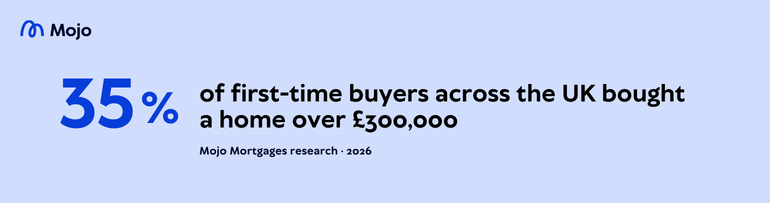
In 2025, we found that 35% of first-time buyers across the UK bought a home over £300,000.***
Not surprisingly, Greater London saw the greatest percentage of first-time buyers dishing out more than £300,000. Harrow saw the highest percentage of first-time buyers at 86.2%, followed by London at 83.8%.
Outside of London, Slough had 80% of first-time buyers purchasing property over £300,000, and Stevenage (66.7%) and Cambridge (66.7%).
We found that Glasgow (9.4%), Cardiff (5.6%), and Aberdeen (0.0%) had some of the lowest percentages of buyers going over £300,000.
Scenario:
You’re buying with someone else
In 2026 so far (from January to April), we found that there is more or less an even split of buyers who are going at it alone, and those buying with someone else. In April, we found that 49% of first-time buyers were sole proprietors, with 51% going in on a joint mortgage. The scales were tipped in January 2026 where 56% of first-time buyers were solo, with 44% joint borrowers.****
Whether you are buying with someone else or getting a mortgage on your own, be sure to get your finances prepped. Ideally, work with a trusted mortgage broker who can help with advice and scour the market for deals.
Assess your finances
Subscriptions – A good place to start is to look over your finances, like a lender will. Lenders are now scrutinising “subscription creep” as streaming services become more dominant. Audit your bank statements for any unused gym memberships or streaming services you no longer need.
Debt-to-income – Avoid taking out any more debt before starting the mortgage process. Even if a small car loan is shared, a £200/month car payment, for example, could impact your affordability.
The Lifetime ISA (LISA) – The 25% government bonus is still active. In our spring 2026 survey, we found that 37% of UK Lifetime ISA owners deliberately bought a cheaper home (compromising on size or area) to avoid the LISA £450,000 price cap penalty (25% withdrawal charge).
In contrast, only 26.4% of respondents with a LISA reported that they were able to use their LISA as intended within the current rules without having to alter their home-buying plans. By working with a mortgage broker, buyers can identify a clear and personalised path to homeownership.

Strategic mortgage product choice
Making sure you choose the right mortgage for your first one means shopping around and talking to an expert who can advise. There are variable and fixed-rate mortgages. Here’s what we’re finding at the minute:
Tracker mortgages (a type of variable mortgage) are becoming more popular. With the Base Rate at 3.75% (May 2026), trackers may be good for those who think there will be further rate cuts. On the other hand, the Bank of England may increase the rate, which would increase your monthly payments.
For those prioritising long-term certainty, a 5-year fix may be worth considering. Currently, these are priced more competitively than 2-year options, reflecting market expectations that interest rates may remain stable or decrease over time. The rates are subject to change before you secure a deal.
If your budget is tight, a 5-year fix ensures your monthly outgoings remain unchanged for a long stretch of time. Or, if you expect your income to rise (for example through a promotion at work), a 2-year fix may provide the flexibility to remortgage sooner, potentially at a lower loan-to-value (LTV).
We recommend talking to your mortgage broker who can discuss your options – and you can ask questions about choosing the right mortgage to suit your needs.
Top mortgage choices for first-time buyers
Santander offers a 98% mortgage called My First Mortgage to help buyers get on the property market.
Nationwide’s Helping Hand mortgage allows eligible first-time buyers to borrow up to 6x their annual income, significantly higher than the standard 4.5x cap found at most banks.
If you're renting or haven't owned a property in the last three years, Skipton’s Track Record mortgages offer low to no deposit options.
Barclays offers a Family Springboard Mortgage, where family members can support borrowers without gifting money outright.
Please keep in mind that the above are products currently available, but they can be changed or withdrawn by the lender at any time, without notice. One of the best ways to know what current deals there are (and that are available to you) is to speak to a mortgage broker.

Expert and first-time buyer mortgage broker advice
If you have questions about getting a mortgage as a first-time buyer or need expert mortgage broker advice, the team at Mojo can help. We’ve helped thousands of people with their mortgage with free, honest advice – here’s how we make our money.

Disclaimer: Every effort is made to provide accurate information as of the publishing date. However, given the fast-moving nature of the mortgage market, products or rates may have changed since this was written.
Sources:
* Data shown is from Mojo Mortgages’ own customer records, covering the period between 1 January 2023 to 31 December 2023 and 1 January 2024 to 31 December 2024, looking at the average deposit and average initial monthly payment.
** Data shown is from Mojo Mortgages’ own customer records covering periods between 1 January 2024 to 31 December 2024 and 1 January 2025 to 31 December 2025, counting the number of first-time buyers who received a deposit marked as gifted.
*** Data shown is from Mojo Mortgages’ own customer records covering the period between 1 January 2025 to 31 December 2025, for first-time buyer count and those that purchased a property over £300,000 across England, Scotland, Wales, and Northern Ireland.
**** Data shown is from Mojo Mortgages’ own customer records covering the period between 1 January 2026 to 30 April 2026, for first-time buyer count and the percentage of which were sole proprietors and which were joint borrowers.